The Colonel Richard Gimbel Aeronautical History Collection

Prints  1797 – 1909


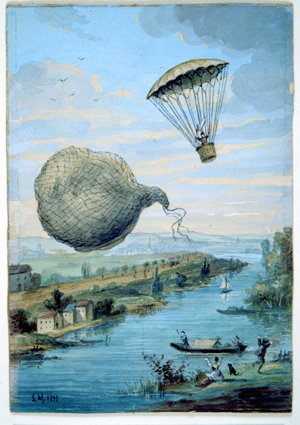
[Garnerin's descent by parachute]

Étienne Chevalier de Lorimier (1759-1813)
Gouache over graphite, 18.5 x 13 cm.   
XB-9-3A (4603)

This handsome painting shows what is thought to be the descent by André Jaques Garnerin on October 22, 1797. On that day, Garnerin launched his hydrogen balloon from Parc Monceau in Paris and descended by parachute from 3,000 feet. His descent was successful except that the parachute, which had no provision for spilling air, developed violent oscillations. The painting bears the signiture "L.M.," which is that of Étienne Chevalier de Lorimier.


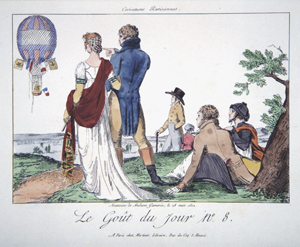
Le Goût du Jour no. 8.

Paris, [1802].  Captioned "Ascension de Madame Garnerin le 28 mars 1802."  At top is the phrase: "Caricatures Parisiennes."
Lithograph, colored, 16.4 x 23.7 cm.
XP-XL-11 (1399)


This plate emphasizes the new clothing fashion of the early nineteenth century, with its high-waisted styles. The men sport exaggerated beaver hats and coats, which are cut dramatically away at the waist with long tails; the woman at left carries a fan, and she is draped with a colorful wrap. Jean-Geneviève Garnerin, wife of André Jacques, is considered the first female pilot and the first woman to descend in a parachute. In addition, their niece, Elisa Garnerin, considered the first professional female parachutist, made about forty descents between 1815 and 1836.


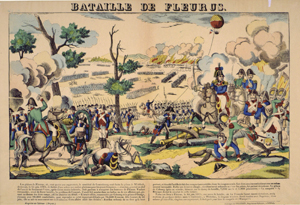
Bataille de Fleurus.

Fabrique de Pellerin . . . à Epinal
Epinal (France), [after 1815], Wood engraving, 32 x 53.3 cm.   
XP-XL-25 (2019)


One of the first uses of the balloon in war was at the battle of Fleurus on June 26, 1794. The balloonists made important observations and relayed information that provided a real advantage to the French army, which faced 52,000 Austrian and German troops. Information from the airborne observers allowed General Jean-Baptiste Jourdan (commander, Armée du Nord) to monitor the rather unorganized movements of his enemy and repulse them in a battle of six hours; the battle is considered pivotal in the War of the First Coalition, which ended in 1797. After making repeated attempts to advance into the region around Fleurus during 1794, Jourdan and his army were very much discouraged by the time of the battle, but the general was urged on and even threatened by the civil commissioners of France. The publisher of this print, the Fabrique de Pellerin, produced rather simple images for the general public; it was named for its founder, Charles Pellerin (1756-1836), who produced many celebratory works such as this in the town of Epinal, famous as a center for popular images.


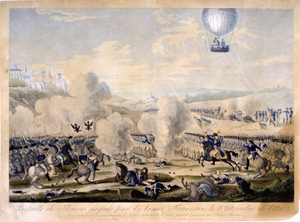
Bataille de Fleurus gagnée par l'Armée Française, le 8 Messidor, de l'An 2

Pierre Adrien Le Beau (1748–? ), after a drawing by Naudet
Engraving, 33.4 x 48.6 cm.
XL–25 (2020)


Another view of the battle of June 26, 1794, shows the coalition troops on the left and the French on the right, with the balloon aloft above the battle. The French balloon company, organized in April 1794, has been called "the first air corps in history," and its objectives were threefold: to provide reconnaissance, to relay signals between units on the ground, and to spread propaganda from the air. By June 10, 1794, the French balloon company had joined Gen. Jean-Baptiste Jourdan's army at Maubeuge and began to provide reconnaissance from the air. A second company was formed on June 23 but was not deployed until 1795.  Both units were active until the 1st company and its balloon were captured at the battle of Würtzburg on September 3, 1796. Despite some success, the French balloon corps was troublesome to maintain, and it was disbanded in 1799.


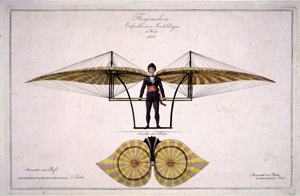
Flugmaschine. Erfunden von Jacob Degen in Wien, 1807

Etching, colored, 28.2 x 43 cm.   
XP-XL-18 (1780)


Swiss watchmaker Jacob Degen constructed this ornithopter and began trials with it in 1806, first using a counterweight to help hoist it and keep it aloft, and then employing a small balloon. He gave demonstrations in Vienna and then came to Paris, where in 1812 the aircraft was destroyed by a mob. Degen rebuilt it, trying it again in Paris in 1813 and in Vienna in 1817. He is known to have experimented with a small helicopter in 1816. It is said that Degen's trials were the motive for Sir George Cayley to publish his famous paper "On Aerial Navigation," which appeared in the Journal of Natural Philosophy in three parts in 1809 and 1810.


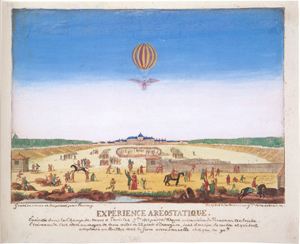
Expérience aréostatique. Exécutée dans le Champ-de Mars à Paris le 27bre 1812 par M.r Degen, mécanicien de Vienne en Autriche

Foursny  "Gravé sur verre et Imprimé par Foursny. Deposé à la direction gale de la Librairie."
Etching or engraving on glass, colored, 24.1 x 19.6 cm.
XB-8-3B (1049)


The text of this print emphasizes the success of Degen's ornithopter in its trial of September 2, 1812, and makes it clear that the mechanical wings were the important part of the aircraft, since the attached balloon provided only "90 pounds of ascensional force." As the phrase "engraved on glass" at lower left relates, this image is printed from a glass plate—an uncommon and a relatively short-lived intaglio technique. (Gimbel XB-8-3B 1004 shows the mob destroying the ornithopter on October 5, 1812.)


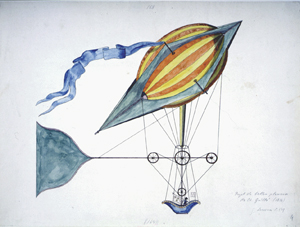
Projet de ballon planeur de Ch. Guillé (1816)

Ink and water color on (hand-made) paper,with manuscript annotation: "Projet du ballon planeur de Ch Guillé (1816) Lecornu p. 139," 29.6 x 41 cm.   
XL-11 (1387)


Louis Charles Guillé made this elongated envelope with long stabilizing surfaces, which were meant to guide the balloon forward while it ascended and descended.  On November 13, 1814, Guillé demonstrated this unsuccessful craft in the Champ de Mars in Paris. The design enjoyed continued life when Jules François Depuis-Delcourt published it (as plate 5) in his Nouveau manuel complet d'aérostation of 1850. The inclined plane is a fairly common concept for guiding balloons; for example, in 1851 it was advocated by Constantino Cernuschi and in 1859 by John Wise. Guillé made the first parachute descent in the United States, when he dropped from a balloon over New York on August 2, 1819.


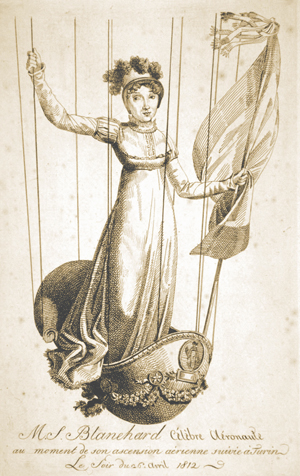
M.S. Blanchard Célèbre Aéronaute, au moment de son ascension aérienne suivie à Turin, Le Soir du 26 avril 1812

Etching and engraving, 28 x 17.8 cm.   
XP-XL-20 (1819)

The professional aeronaut, Marie Madeleine Sophie Blanchard, was the wife of Jean-Pierre Blanchard, whom she married in 1798.  She was well known for her night ascents. Her sixty-seventh ascent, in July 1819, was her last. Although the accounts of her last flight are contradictory, it appears that after fireworks were lit below her basket, the balloon caught fire; she extinguished the fire and arrested the descent of the balloon but finally collided with a roof and was thrown from the basket to the ground and killed. Marie Blanchard was Jean-Pierre's second wife (he had married Victoire Le Brun in 1774 and abandoned her in 1779). (Bruel [no. 143] reproduces another version, dated 15 August 1811, celebrating Marie Blanchard's ascent in Milan, which is signed at lower left "N.H.G." and at lower right "L. Rados." This print can also be found with the date 19 April 1812; Caproni shows the two prints [15 August 1811, and 19 April 1812] side by side [no. 73].)


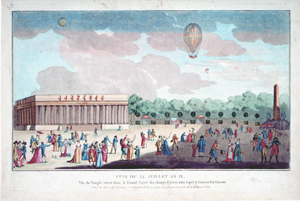
Fête du 14 Juillet an IX.

[Paris? 1801?].   
Engraving, colored, 23.7 x 41.4 cm. (image) 
XP-XL-9 (1300)


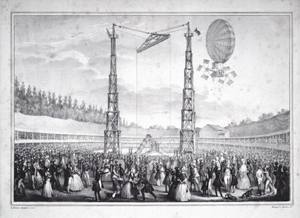
Numerous prints celebrate the commemorative use of the balloon in official functions, especially in the Napoleonic era. This print represents a celebration on July 14, 1801, which commemorated the formation of the French republic, a day then referred to as the "Anniversary of the Federation" by the French and now referred to as Bastille Day by English-speakers. It memorialized the taking of the small state prison and fortress, the Bastille, on July 14, 1789, by Parisian citizens after a four-hour battle; to the revolutionaries, the prison represented the arbitrary power of the king, who could imprison without trial.  In 1801 the Anniversary of the Federation began at six in the morning with thirty rounds of cannon fire and included displays of statuary, pantomime exhibitions, skits, balls, orchestras, and the balloon ascension depicted here. In the evening, the theatres were opened to the public without charge, and fireworks decorated the sky.

This view of the Champs Elysées shows the scene of the festivities, and the caption relates that a "temple has been constructed in the square of the Champs Elysées, in which the concert was held." The balloon in the background is shown dropping a parachute; it probably is that of André Jacques Garnerin. In the upper left a small, unmanned balloon can be seen. (The Gimbel collection includes numerous examples of this genre, including: XP-XL-9 1318: "The Chinese Pagoda and bridge . . . for the Grand Jubilee of the 1st of August"; XP-XL-9 1319: "Coronation procession of his Majesty George the Fourth 19 July 1821"; XP-XL-9 1321: "London Bridge opened by King William IV and Queen Adelaide, August 1, 1831"; XP-XL-9 1330: "Révolution Française 1848, fête de la Concorde"; XP-XL-11 1369: "Vue perspective du Champ de Mars le jour de la fête donée le 24 Juin 1810"; XP-XL-11 1386: "Entrée triomphante de S.M. Louis xviii dans sa capitale.")



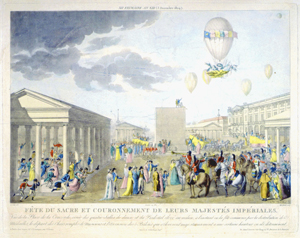
Fête du sacre et couronnement de leurs Majestés Impériales.  Vue de la Place de la Concorde

Jacques Marchand (1769–? ), engraver, and Jean-Baptiste Gautier, etcher, after a drawing by Louis Le Coeur
Paris, [1804?].   
Etching and engraving, colored, 35.7 x 45.8 cm.
XP-XL-9 (1305)


On December 2, 1804, Napoleon and Josephine were crowned emperor and empress of the French, and the public celebrations included a parade of musicians and the launch of balloons. This view is taken from the Place de la Concorde on December 3. Five balloons were launced that day, including the one shown here, which carried a massive eagle, surrounded by flags and surmounted by a garland. The balloons were designed to be consumed by fire while aloft, adding to the spectacle. Another balloon, carrying an imperial crown, flew all the way to Rome, where part of it is said to have been deposited on the tomb of Nero. André Jacques Garnerin, who executed the coronation event, reportedly lost his job over this incident and was replaced by Marie Blanchard. The life dates of the artist, Le Coeur, are not recorded, but he was born during the second half of the eighteenth century and is known for his prints of the French Revolution.


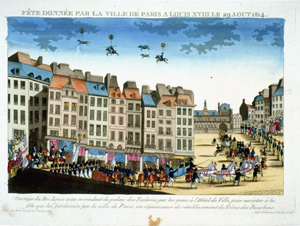
Fête donée par la ville de Paris à Louis XVIII le 29 Aout 1814

Paris, [1814?].
Etching, colored, 26 x 40.5 cm.   
XP-XL-9 (1320)


In 1814 the allied armies of Europe at last overcame Napoleon and entered Paris. Napoleon, no longer the hero of France, was exiled to Elba. In the vacuum that ensued after Napoleon's abdication, the allied powers agreed that a restoration of the Bourbons was the safest and best choice. This scene shows the return of Louis XVIII to Paris; the procession of the king was accompanied by the launch of a series of aerostatic animals and riders on horses. (An English print [XP-XL-9 1310] shows the same event but depicts a full-sized and manned balloon.)


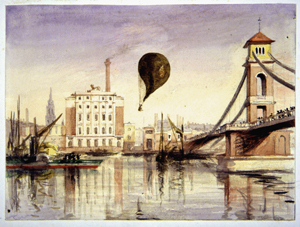
New Hungerford Market, London; Graham's balloon on opening day, 2 July 1833]

Watercolor, 15 x 20 cm.   
XP-XL-9 (1323)


This scene depicts the New Hungerford Market and the celebration that opened it in 1833. The old Hungerford Market had been established in 1680 but had never prospered and was rebuilt in 1833 as a meat and vegetable market. It was demolished about 1860, when the Charing Cross Railway Station was constructed nearby. George Graham was active as a balloonist from 1823 to 1851; his wife, Margaret Graham, was active from 1824 to 1853. (Gimbel XP-XL-9 1324 is a print showing three people in the basket at lift-off.  Marsh [plate 80] shows another print by M. O'Connor, London, "View of the New Hungerford market as it appeared at the opening on the 2nd of July 1833.")


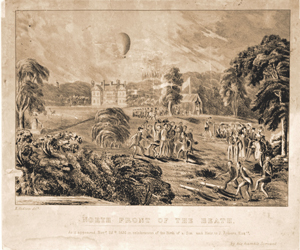
North Front of the Heath.  As it apeared Nov.r 25.th, 1836 in celebration of the Birth of a Son and Heir to J. Ackers, Esq.re

E. Hodgson [1836?].   
Lithograph, 20.3 x 29 cm.   
XP-XL-9 (1328)


A spirited celebration with cannon fire, marching band, roasted viands, and a balloon ascension commemorated the birth of James Ackers, Jr., born on November 18, 1836. Beyond the information provided by the print, we know only a few biographical details concerning the family. James Ackers' parents were married in 1832. His mother, Mary Williams Ackers, died in 1848. His father, James Ackers (1811-1868) was a Member of Parliament for Ludlow in Shropshire, England, from 1841 to 1847. It is unclear where this scene occurred, as the family did not acquire Prinknash Manor southeast of Gloucester, until 1847. James Ackers, Jr. died in December 1859 at the age of twenty-three.


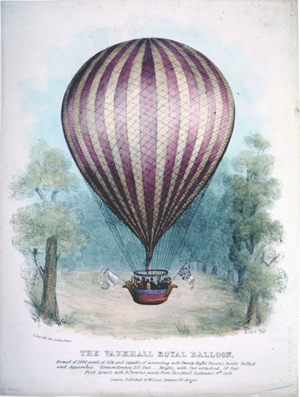
The Vauxhall Royal Balloon, Formed of 2000 yards of Silk

F. Alvey, after W.S. (William Spooner?)   London, [1836?]. Published by William Spooner.  Signed lower left (in image): "W.S."
Lithograph, colored, 30.5 x 23 cm.   
XP-XL-12 (1406)

Charles Green designed this balloon, which had its first flight on September 9, 1836. The crowded car was reportedly capable of carrying 28 people. The Vauxhall Royal Balloon, which was about 70,000 cubic feet in capacity, was built under the auspices of London's Royal Vauxhall Gardens as an attraction.


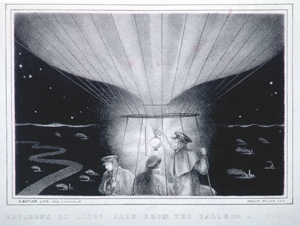
[Environs of Liège, seen from the balloon at night]

A. Butler, after a sketch by Monck Mason
[1836?].
Lithograph, 11.5 x 16.5 cm.   
XP-XL-12 (1410)


This innovative sketch shows the Vauxhall Royal Balloon as it flies over Liège, Belgium, with blast furnaces visible below. The creator of this sketch, Monck Mason, accompanied Robert Holland with Charles Green as pilot on a voyage of about 380 nautical miles from London to a place near Weilburg, Germany.  Mason described the flight through darkness as "clearing our way through an interminable mass of marble." It was a flight of eighteen hours, beginning on November 7, 1836. A broadside advertising the balloon (see "Grand new balloon, to be called the Vauxhall Royal Balloon," XP-XL-12 1404 in Other Holdings) describes the many virtues of this aircraft, first flown in September 1836; its large capacity would allow it to ascend to hitherto unattained heights and seek out "currents of air proceeding in one direction for several months together." For the flight pictured here almost 100 pounds of food and 2 gallons each of sherry, port, and brandy were carried. The journey received much publicity, and the Vauxhall Royal Balloon was renamed the Great Balloon of Nassau to honor the Duchy of Nassau, where the balloon landed. It remained in service for 35 years and was purchased by the balloonist Henry Coxwell who used it for the famous ascent shown in print XP-XL-14 1508.


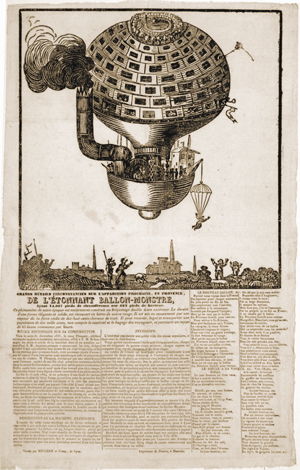
Grands détails circonstanciés sur l'apparition prochaine, en Provence, de l'étonnant ballon-monstre

Marseille, [1839?].
Letterpress with woodcut, Imprimerie de Nicolas, à Marseille, 25.8 x 24.2 cm.
XP-XL-16 (1646)


This simply executed print parodies the beginnings of the Chartist Movement in England, which called for egalitarian reforms. In 1839 more than a million Englishmen signed a "monster petition" stating six demands, including annual meets of Parliament and universal male suffrage. The monster petition was presented to Parliament on July 12, 1839, and rejected the same day. On July 22, the Chartists called for a "sacred month"—a general, month-long strike to begin on August 12. A week before the strike was to begin, the movement's leaders acknowledged a lack of support for a prolonged protest and called instead for a strike from August 12 to 15, predicting that the government would collapse by the latter date. Equating the events in England with this obviously unwieldy scheme for a flying town, the text of this French print reports the flight of the ballon-monstre on August 15. Elaborating on Étienne Robertson's Minerve of 1804, the print depicts a balloon with a railroad that runs around the exterior of the envelope, 24 streets containing 80 houses each, boulevards with cafés and a complement of soldiers. The text advertises a flight from England to France for 4,568 passengers on January 3, 1840.


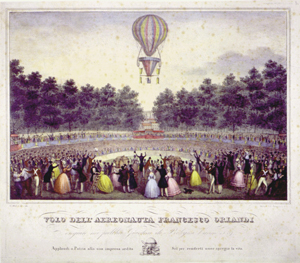
Volo dell' aereonauta Francesco Orlandi eseguito nei pubblici Giardini di Bologna l'anno 1839

G. Meloni   
Lithograph, colored, 28 x 41.2 cm.
XP-XL-12 (1423)


Despite the death in June 1785 of Pilâtre de Rozier and Jules Romain in their combination hot-air and hydrogen balloon, experimenters continued to build balloons that combined these elements. The aeronaut Francis Olivari lost his life in one on November 25, 1802, at Orléans, as did Francesco Zambeccari on September 21, 1812, near Boulogne. Francesco Orlandi, whose balloon is shown in this print, seems to have been the most successful with these aircraft.  Orlandi published a treatise on ballooning, suggesting his new design, in 1800. His first flight did not occur until August 30, 1825, after which he made 40 flights. This print commemorates his flight on July 22, 1839, when he ascended from the public gardens in Bologna. His work was furthered in print, although not in practice, by his son Guido as late as 1871. Others, including Pascal Andreoli and Phillipe Silvestrini, experimented with combination balloons in Italy during the first decades of the nineteenth century.


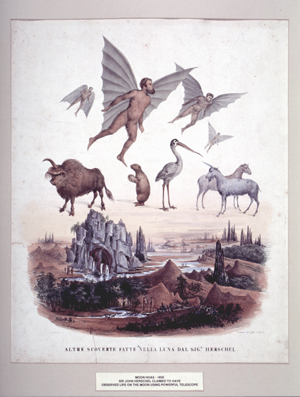
Altre scoverte fatte nella Luna dal Sig.r Herschel

Naples, 1836.
Lithograph, colored, 50 x 41 cm.
XP-XL-27 (2251)

The New York Sun temporarily boosted its circulation in August 1835 with reports by astronomer John Herschel of "man bats" that roamed the "pebbly beaches" of the moon. The story, ostensibly copied from the Edinburgh Journal of Science but actually written in New York by Richard A. Locke, became quickly known around the world, in part because the Sun sent the report abroad in the form of a generic pamphlet. The Sun ran Locke's detailed observations daily from August 25 to August 31, while "the almost universal impression and expression of the multitude was that of confident wonder and insatiable credence." Edgar Allan Poe, who had just begun the publication of his own serial story describing Hans Pfaal's voyage to the moon, later wrote that people should have known better, especially since the description of the wings in Locke's report "was but a literal copy of the wings of his flying islanders"—a reference to the hero of The Life and Adventures of Peter Wilkens by Robert Paltock, published in 1751. The Sun lauded itself for "diverting the public mind, if only for a while, from that bitter apple of discord, the abolition of slavery," yet skepticism spread more tardily than the hoax had, and as late as 1852 it was reported that the story was still believed in parts of Germany. This Italian print, designed by Leopoldo Galluzzo and published by Gatti e Dura, was part of a series of six published in 1836. Locke's hoax made a considerable impact in Italy where, according to Caproni, twelve pamphlets and twenty prints relating to it were issued in 1836. (In addition to the account in this newspaper, Sun publisher Benjamin H. Day also issued print XP-XL-27 2233, "Lunar animals and other objects discovered by Sir John Herschel," which was reportedly ready for sale when the story's run was completed on August 31, 1835.  The Gimbel collection includes all of the six prints in the Gatti and Dura series: XP-XL-27 2251–2256.)


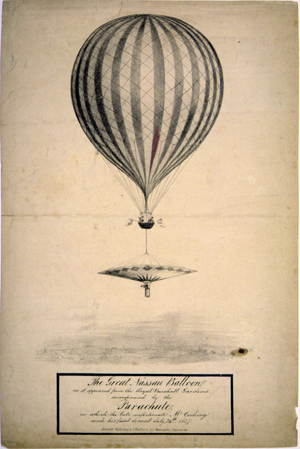
The Great Nassau Balloon . . . accompanied by the Parachute in which the late unfortunate Mr. Cocking made his fatal descent, July 24th, 1837

London, [1837?].  T. Pewtress.
Lithograph, 33 x 22 cm.     
XP-XL-20 (1991)

Robert Cocking, a 61-year-old watercolor painter, had long mused upon the perfection of the parachute. In 1837, he convinced the proprietors of the Royal Vauxhall Gardens to permit their Great Nassau balloon to carry him aloft for a trial. (Print XP-XL-24 1990 is colored, showing a balloon with gores of green, purple, and blue, although this famous balloon was actually red and white. Some of the caption is trimmed off.)


The Ascent of the Royal Nassau Balloon with the Parachute attached, 24th July 1837

Lithograph, 28.4 x 45 cm.
XP-XL-24 (1993)


Robert Cocking had apparently watched a famous parachute descent by André Jacques Garnerin on September 21, 1802, during which the violent oscillations of the 23-foot parachute greatly fatiqued the parachutist. Then 24 years old, Cocking resolved to improve the device and apparently mused upon it for years. He saw the inverted shape as the means to obtain stability during the descent, and he tested his design with small parachutes dropped from diminutive hydrogen balloons. His working model was a heavy contraption, 107 feet in circumference and 10 feet in height, with three metal hoops connected by spars of wood. Weighing 223 pounds, it provided a surface of 124 square yards.  (Garnerin's descent is represented by print XP-XL-24 2000, "Expérience du parachute.")

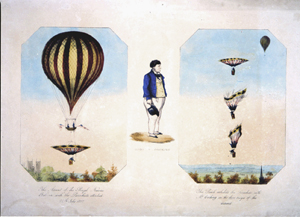
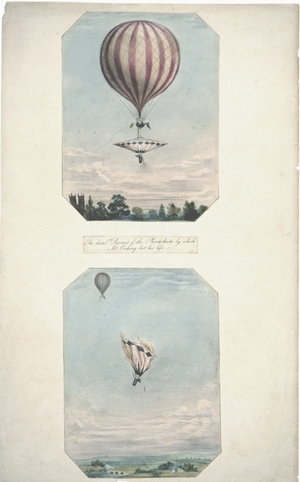
The fatal Descent of the Parachute by which Mr. Cocking lost his life

Lithographs, colored, 21 x 15.5 cm. (each image)
XL-24 (1996)

Robert Cocking tested his parachute on July 24, 1837. Charles Green, the pilot of the Great Nassau balloon, which lifted the parachute, wanted Cocking to be responsible for his own release, so a "liberating iron" was designed and mounted on the balloon and controlled by Cocking from the basket of the parachute. The parachute descended for only three or four seconds before collapsing and then Cocking fell precipitously, dying shortly after contacting the ground. The tragedy generated much attention in the press and among England's printmakers.


[Volo del Bolognese Muzio Muzzi nell'aereonave rettiremiga]

G. Meloni
Bologna, [1838].  Zannoli.
Lithograph, 28.4 x 42 cm.
XP-XL-12 (1414)


Muzio Muzzi of Bologna, son of Professor Luigi Muzzi of the Papal University of Bologna, developed dirigible designs in the 1830s and 1840s. The "aereonave rettiremiga" shown in this print relied on rotating vanes for propulsion and a narrow, disc-shaped envelope for speed. This airship was scheduled to fly on November 4, 1838, but the envelope's failure during inflation prevented the attempt. Another design of Muzzi's, a "Nave Aerortoploa," which called for forward motion given by inclined planes while the airship ascended and descended, was patented in Europe and the United States. The airship was never built, but a model was exhibited in New York in 1844, and a pamphlet cataloging support for his ideas was published in 1845. Muzzi, born in Bologna in 1809, died in Cuba in 1846. (Another depiction: XP-XL-31 2729 shows two images of this aircraft, one with paddles mounted on the equator of the balloon, the other with the paddles mounted on the basket.)


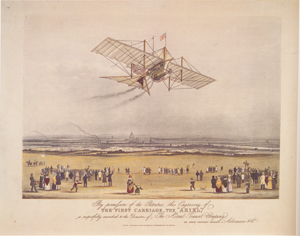
The First Carriage, the "Ariel"

London, 1843. 
Colored lithograph, 23.2 x 33 cm.   
XP-XL-19 (4682)


John Stringfellow and W.S. Henson worked together to produce what became well known as "Henson's aerial steam carriage," an airplane that certainly resembles the machine that was invented fifty years later. The Aerial Transit Company, in which the inventor Frederick Marriott was involved, heavily publicized the steam carriage and issued a number of promotional prints showing the aircraft in flight over various landmarks around the world. Both the Illustrated London News (April 1, 1843) and the Parisian L'Illustration (April 8) published views of the machines with drawings of the workings, although in other forums the plans met with ridicule. In 1847 a model of the steam carriage, with a 20-foot wingspan, failed in trials, and the discouraged Henson abandoned the invention. Stringfellow, however, pursued it and prepared a working model in 1848, followed by a less successful model triplane, which he exhibited at the Aeronautical Exhibition in the Crystal Palace, London, in 1868. (The full caption reads: "By permission of the Patrons this engraving of the First Carriage, the "Ariel," is respectfully inscribed to the Directors of the Aerial Transit Company by their obedient servants . . ."  Another print depicting the "Aerial" in the Gimbel collection is 1788: ". . . The first carriage, the 'Ariel'." London, 1843 [XP-XL-19].  Another copy, XP-XL-19 1788c, is not colored.)


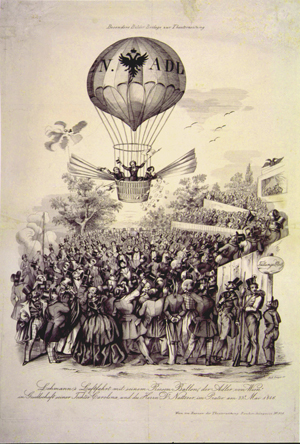
Lehmann's Luftfahrt mit seinem Riesen Ballon, der "Adler von Wien" . . . 23 Mai 1846

Andreas Geiger.  Wien. [1846?]. At head: Besondere Bilder Beilage zur Theaterzeitung.
Engraving, 39 x 27.7 cm.
XP-XL-12 (1431)

Shown in the basket are Christian Lehmann, his daughter Caroline, and the Viennese scientist Dr. Johann F. Natterer. Caroline is throwing handbills from the basket, while the two men are involved in the customary waving of hats and flags. The wings on either side of the basket are presumably meant for propulsion.


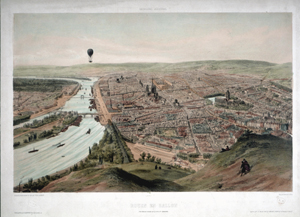
Rouen en ballon.  Vue prise au dessus de la Cote Ste. Catherine

Jules Arnout (1814-1868)  Paris, 1846. Top: "Excursions aériennes."
Lithograph, 29 x 44.8 cm. "Impression par Lemercier, à Paris."
"Drawn from nature and lithographed by Jules Arnout.  London.
Published 25 March 1846."
XP-XL-10 (1340)


Jules Arnout, a student of Jean Sebastian Rouillard (1759-1850), was known for his landscapes of Italy, France, and Great Britain. The symbol "1" at bottom center may indicate that this is first in a series. (Print XP-XL-10 1341 is same with black and brown only. Compare, from the same series, XP-XL-10 1342; "Brighton. View taken in balloon. Brighton. Vue pris en ballon." The Gimbel collection includes nine of Arnout's aerial views of English and French cities, numbered XP-XL-10 1341-1349, about half dated 1846 and half undated. Included are views of Paris, Versailles, Blois, St. Cloud, Windsor, and Brighton.  Print XP-XL-20 1843 is a view of Alameda, Mexico.)


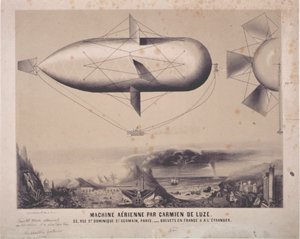
Machine aérienne par Carmien de Luze

Lithograph, 36.5 x 49 cm.   
XP-XL-18 (1756)


Carmien de Luze designed this airship, in which the envelope rotates on its longitudinal axis and propulsion is provided from the vanes striking the air.  According to John Grand-Carteret, the design was patented in 1862, and the airship itself was to appear in 1864. The design evokes both an earlier and later manifestation of the rotating envelope scheme: Pierre Ferrand's plan using a helical arrangement of planes around the envelope in 1835; and the Cyclocrane introduced in Oregon in 1984, which rotated its envelope in order to provide lift from airfoils fixed longitudinally around its periphery. Below the ship is a bizarre scenario of disaster and ruin, including a battle, a safari with elephants, a shipwreck, a ship struck by lightning, and a waterspout.


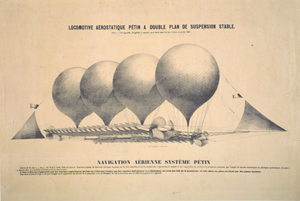
Locomotive aérostatique Pétin à double plan de suspension stable . . . Navigation aérienne système Pétin

[1850?], [Paris]. "Lith. Castille."
Lithograph, 29.5 x 55 cm. (image) on a sheet 40.4 x 59.8 cm. 
XP-XL-18 (1769)


Ernest Pétin, the designer of this aircraft, announces in the caption that it "will be launched into the air at Paris in July, 1851." Several methods are possible: the helical screws could be turned "by hand or by some other mechanical means" or the inclined planes could convert the vertical movement to forward motion, as in the design of Charles Guillé. A patent was issued for this aircraft on May 8, 1848. (What may be the original design for this large lithograph is an uncatalogued watercolor painting [16.5 x 22.5 cm.] in the Gimbel group "uncataloged matted prints.")

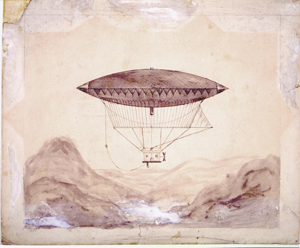
[Le Ballon dirigeable de Mr. Giffard—1852]

(Title in manuscript on mounting.)
Pen and ink drawing with wash, 19 x 22.7 cm.   
XP-XL-18 (1766)


A 3-horsepower steam engine powered this dirigible designed and flown from Paris by the renowned engineer Henri Giffard on September 24, 1852. Emile Cassé witnessed the flight and was struck by "the strange feeling we felt as we saw the brave inventor rise up in his machine to the whistling noise of the steam, replacing in these circumstances the usual waving of a flag." The aircraft was able to develop a speed of about 5 miles per hour. "Not for a single moment did I dream of struggling against the wind; the power of the engine would not have permitted it," Giffard reported. "That had been thought of in advance and proved by calculations; but I carried out various manoeuvres of circular and lateral movement successfully." Giffard built a second machine that was launched in 1855; it was similar to this one, but 230 feet long as opposed to 144. It failed during the initial flight. (This drawing shows a car with solid walls rather than the open nacelle of the actual machine.)


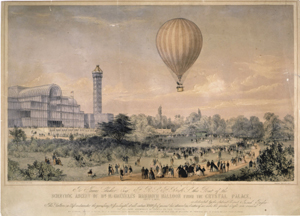
Scientific Ascent of Mr. H. Coxwell's Mammoth Balloon from the Crystal Palace, Sept. 1, 1862

C. Robinson, after a drawing by J. Taylor. London, September 13, 1862. "C. Robinson, Litho." 
Tinted Lithograph, colored, 37 x 60 cm.
XP-XL-14 (1508)


This flight was part of a series made famous by the corresponding publication of James Glaisher’s Voyages Aérienes and Travels in the Air. Glaisher claimed that during a scientific ascent a few days after the flight depicted here, on September 5, the valve line was lifted out of reach, the balloon went into an uncontrolled ascent, and rose to 36,000 feet before one of the balloonists regained control of the valve. The claim is rather incredible, as the ballooninsts could not have survived this altitude; it is thought that 24,000 feet is a more probable altitude. The caption asserts that the balloon "attained the elevation of six miles, the greatest height ever reached."


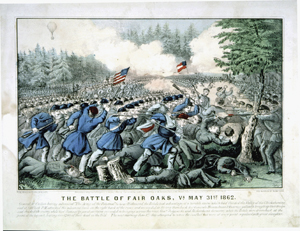
The Battle of Fair Oaks, Va. May 31st, 1862

New York, 1862. Currier and Ives,
Lithograph, colored.  20 x 31.4 cm.       
XP-XL-25 (2034)


Bruce Catton described the Civil War battle at Fair Oaks as "bloody enough, with five or six thousand casualties on each side, but . . . indecisive. The diaries of the men who fought in it cannot be put together to make a picture of anything but a series of savage combats in wood and swamp . . . there seemed to be no tactical plans other than a simple urge to get the men up into places where they could shoot at each other." Above this scenario, balloonist Thaddeus Lowe attempted to keep the Union army informed of enemy activity by ascending in three different captive balloons on the day of the battle. He claimed that this scouting was the most significant of his war-time service, as he was able to prepare the Union army for the attack with which the battle began. It was the most severe action that Lowe witnessed. Currier and Ives, the famous New York firm, which issued over 7,000 different images from 1857 to 1907, made three versions of this print, all titled as above and issued in 1862. Such scenes were standard fare for the firm, which published more than 70 prints whose title began with the word "battle." The Union army ceased using balloons after June 1863. (Included in the Gimbel collection is the uncolored version XP-XL-25 2034 [sic]; the two prints are very similar and are the same size. The uncolored has, as the first word in the last line of the caption, the word "bajonet," where the colored has "point of the bayonet." The principal difference in the two images is the position of the horseman's sword at upper right, which is pointed backward on the colored and forward on the uncolored.)


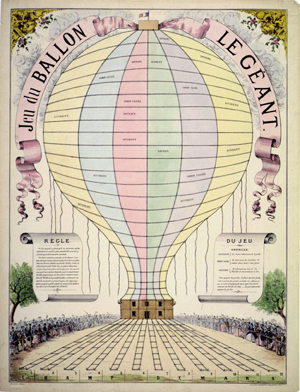
Jeu du ballon, Le Géant

Paris, [1863?].  Published by Rousseau, printed by Destouches, Paris.
Lithograph, colored, on paper, 60 x 44 cm.
XP-XL-22 (1875)

This board game is inspired by the huge balloon Le Géant, built by the famous photographer and aeronautical enthusiast Nadar (or Félix Tournachon). Le Géant held 212,000 cubic feet of gas and produced a lift of more than four tons; below this massive envelope was a two-story wicker car with a balcony, passenger compartments, a photographic lab, and a printing press. The balloon made two flights in 1863 from the Champ de Mars, on October 4 and 18. The first flight, with Nadar in command and two of the Godard brothers as assistants, carried twelve additional passengers. It ended only fifteen miles from Paris, probably because of a badly seated gas valve at the crown. The second flight was an overnight voyage of 400 miles, with Nadar and the Godards accompanied by six passengers; it ended with a spectacular crash landing in Germany. This flight was sensationalized by the press, and this board game was probably inspired by it. The game is played with dice, and the players advance from the twelve spaces at bottom (the "Champ de Mars") up the tether lines and net to the crown of the balloon. Players suffer penalties if they land on "accident" or "broken rope."  Landing on "valve" requires descent to the bottom of the basket, or car. Nadar flew Le Géant from various European cities until 1867.
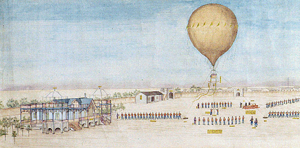

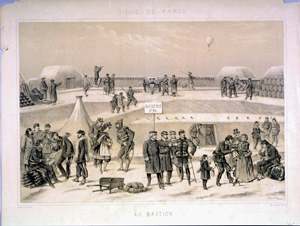
Siège de Paris, Au Bastion

Draner (i.e., Jules Renard, 1833–? ), artist and lithographer
Paris, [ca. 1870]. 
Tinted Lithograph, 54 x 34.2 cm.   
XP-XL-14 (1506)
 

Sixty-six manned (and one unmanned) balloons, departed from Paris during the siege of 1870-1871, bringing out large quantities of mail and dispatches and, occasionally, political leaders needed for the war effort outside the besieged capital. This scene from the Franco-Prussion War appears to be apocryphal—the bastion shown, "No. 95," never existed.  Renard, whose pseudonym consisted of his name spelled backward, also published a series of colored views on the siege in book form, including Souvenirs du siège de Paris: les soldats de la République; Souvenirs du siège de Paris: les défenseurs de la Capitale; and Paris assiégé.


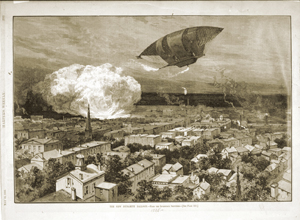
The New Dynamite Balloon—from the inventor's sketches

Wood engraving, 23.5 x 34.5 cm.   
XP-XL-18 (1755)


This print appeared in Harpers Weekly of May 23, 1885. A short accompanying article discusses the proposal of Russell Thayer, who designed the 185-foot-long "dynamite balloon" and suggested its use to the U.S. Navy. The airship was to drop "huge bombs" of dynamite, a material invented almost twenty years earlier but only recently embraced by the military. Although the article concedes that a satisfactory method for propelling airships was not at hand, it noted that "new methods hold out new possibilities." Predicting that recently developed engines would provide a solution, the article compares the advent of the airship to that of the marine screw propeller, concluding that the airships' "value in peace might overshadow their war uses." In France, in 1883 and 1884, Albert and Gaston Tissandier and Charles Renard and Arthur Krebs had launced electrically propelled airships that were only moderately successful. In the print, the artist dramatically shows discharged smoke, suggesting the use of steam. Two men are shown standing in the car, from which a bomb has just been dropped.


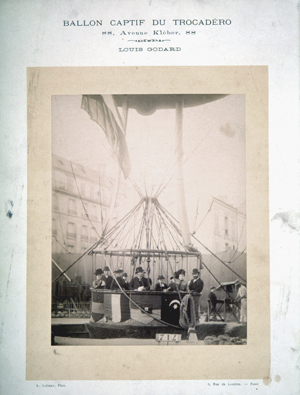
Ballon captif du Trocadéro . . . Louis Godard

Alphonse J. Liébert
Paris, [1889].
Photograph, 21.5 x 16.9 cm.   
XP-XL-14 (1514)

Dated 1889, this photograph shows the large captive balloon managed by Louis Godard, nephew of the famous Eugène Godard, a pioneer in the genre of the large balloon. Both were balloon builders, and the family included numerous balloonists, led by Eugène; Pierre, father of Eugène, and Eugène's brothers and sisters—Louis (son of Louis who managed the pictured balloon); August, Jules, and Eugénie. In fact the Godard name became so closely associated with the balloon that in 1960 historian Charles Dollfus claimed he could still find people in the French countryside who referred to any spherical balloon as a "godard." This view was no doubt taken during the Paris Exposition of 1889, which was visited by 32 million people, and during which the Eiffel Tower opened. Liébert, known for applying electric lighting to indoor photography, ran a concession at the Exposition to photograph balloon passengers. In the photograph, ten people fill the basket, which is draped by flags, including, curiously, that of Turkey, which was officially absent from the Exposition. Seen on the right, attached to the basket, is a heavy dragline and anchor, so the balloon is prepared for free flight should it sever its tether. In the background at lower left a wheeled hydrogen generator can be seen. This photograph evokes the famous grands ballons captifs of Henri Giffard, the last of which rose above Paris for the Exposition of 1878 and could carry fifty people; Giffard built his first great tethered balloon for the Exposition of 1867.


[Ascension of a balloon at the Tientsin military academy]

[1887?] 
Scroll, with watercolor on silk;
five panels: three 53.5 cm. x 101.5, one 53.5 x 132, and one 53.5 x 310.


This scroll’s numerous written captions simply name the technical apparatus and other features, but it likely illustrates the activities of the summer of 1887, when the French introduced the first balloon into China. Two balloons were brought from France to the Tientsin military academy near Peking, including one of 3,000 cubic meters that could carry ten people. Though the balloons arrived in early April, the aeronaut Pillas-Panis worked until September instructing the academy’s students and staff in balloon history, technique and maneuvers. On October 2, 1887, Pillas-Panis ascended before a crowd he estimated to contain 200,000 people. By the end of November Pillas-Panis was able to entrust the operation to his students; the improvements to the grounds, including the corrugated metal balloon shed, suggest that the balloons were intended as permanent additions to the Chinese army.


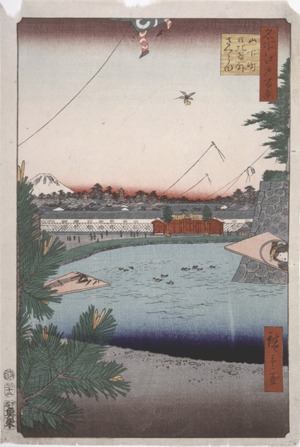
Kites over Sakura District Viewed from the Emperor's Castle

Hiroshige (1797–1858)
Woodcut, 33.7 x 22 cm.
XP-XL-38 (3153)

In this woodcut, part of a series of 100 views around Tokyo produced between 1853 and 1856, Hiroshige, one of the most prominent of Japanese printmakers, shows a number of kites being flown. Presumably the scene is a breezy New Year's Day, since the game hagoita, with its shuttle in the center and paddles shown in the foreground, is generally played then. Kites, which came to the West from the Orient centuries ago, have their origins in ancient times, apparently around 200 B.C.E. They played an important role in the development of the airplane because experimenters extensively used kites to perfect wing structures.


Thirty-six Views Around Fugaku

Hokusai (1760–1849)
Woodcut, 24.7 x 36.8 cm.
XP-XL-38 (3167)


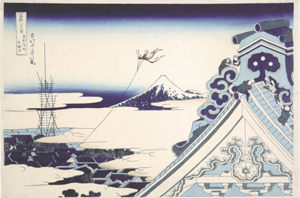
This view is part of a famous series of 46 prints of Fugaku (Mount Fuji) produced by Hokusai between 1825 and 1831, although 36 prints are cited in the title.  Above a bustling scenario, with workmen repairing the Hongan Temple in the foreground, the kite at center commands the scene, including the clouds that partially obscure the dwellings. This print might be compared to early French balloon prints and especially to Tavenard's "Vue de la Terrasse de Mr. Franklin à Passi," which includes the motif of an observer atop a roof. Hokusai was one of the most prominent of printmakers; his "Wave" (also a part of "Thirty-six Views"), which shows a distant Mount Fuji framed by large seas, is familiar to many Westerners.


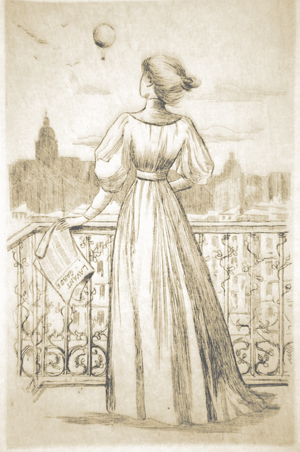
[Woman on balcony looking at balloon]

Dry point, in sepia ink, 15.2 x 9.9 cm.   
XP-XL-16 (1621)

This fin de siècle image is without extraneous words; L'Avant Garde, which serves as the title to the newspaper, also suggests the meaning of the print. The clothing, iron railing, the swept-back hair, and the balloon all contribute to the modernism of the scene, elaborated by the artist's stylistic liberty.


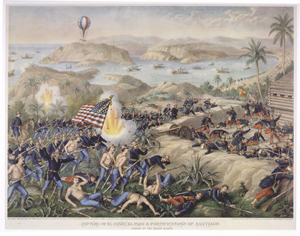
Capture of El Caney, El Paso, and Fortifications of Santiago.  Charge of the Rough Riders.  At lower left: "July 1 & 2, 1898. General Shafter commanding 15,000 troops."

  1. Copyright 1898 by Kurz and Allison,  Chicago.
    Colored Lithograph, 44.8 x 60.2 cm.
    XP-XL-25 (2017)


Under the command of the 300-pound Civil War hero, General William R. Shafter, American troops landed in Cuba on June 20, 1898, to continue the Spanish-American War; the conflict lasted about ten weeks and established Theodore Roosevelt as a national hero. In the battle of El Caney, near Santiago, Lieutenant Colonel Roosevelt ordered his Rough Riders to attack fortifications on the hills above the battleground. During the battle, balloonist Ivy Baldwin ascended several times to observe the action in an antiquated balloon that the U.S. Army had purchased in France in 1892. The intelligence gained from the flights was of great value, but the balloon attracted a great deal of enemy fire onto the surrounding area, and many derided the role of the balloon, pointing out that it allowed enemy gunners to locate the army's position. General Shafter, incidentally, had been awarded the Medal of Honor in 1867 for his heroism in the Battle of Fair Oaks, which is represented in print XP-XL-25 2034.


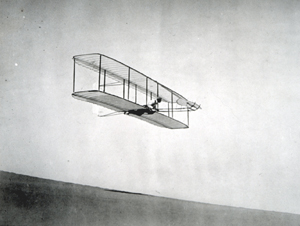
[Wright glider in flight]

Photograph (modern silver print), 29.2 x 37.2 cm.
XP-XL-29 (2314)


This photograph shows one of the Wright brothers in flight during their Kitty Hawk trials of October 1902, after the twin-surface, fixed rudder had been replaced by a single-surface, adjustable one. The new rudder was designed to add much-needed stability, but the Wrights feared it was also going to add to the complexity of flying the aircraft. In Orville Wright's words, the pilot "would now not only have to think, and think quickly, in operating the front elevator . . . he would also have to think so as to operate this rudder." To simplify the pilot's task, the control of the rudder was made automatic and linked to the control for warping the wings and rolling the aircraft; it was later made independent. "With the machine as now constituted," wrote Orville, "we began a long series of gliding flights. The disastrous experiences which we had when the fixed vanes [i.e., the rudders] were used now seemed entirely avoidable." The Wright brothers made just over 300 photographs of their aeronautical work, partly to further and partly to document their own research. Their negatives were bequeathed to the Library of Congress in 1949.


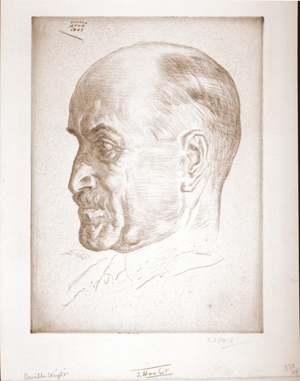
Dayton June 1927 [Orville Wright]

Oscar Edward Cesare (1883-1948).  (Bracketed portion in pencil at lower edge.)
Drypoint, 27.7 x 20.4 cm.
XP-XL-29 (2304)

The Swedish-born Cesare was well known for his cartoons and portraits published in the United States and Europe from the First World War until the Second, and after 1920 he was a regular contributor to the New York Times.  Although Cesare developed the novel technique of portraying and interviewing his subject, this print was published as an illustration to an article by Lester J. Maitland ("Knights of the Air: The Immortal Wrights") which appeared in the September 1928 issue of The World's Work, a periodical that often featured news and commentary on flying. The print shown here was created about the time that Orville Wright met Charles Lindbergh at Wright Field just after Lindbergh had flown the Atlantic alone, and the two had dinner in Wright's home. (A drawing by Cesare featuring a full view of the face of Orville Wright appeared in the August 1925 issue of The World's Work.)


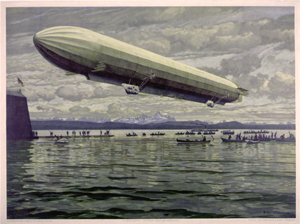
Zeppelin über dem Bodensee

Michael Zeno Diemer (1807- ? )
München, 1909.  Reichold and Lang. 
Colored lithograph, 55 x 75 cm.   
XP-XL-C (3099)


This poster was created in 1909, a significant year for Count Ferdinand von Zeppelin and his dirigibles. An airship (LZ5) was completed in the spring, funded largely by contributions from the German people, and on May 29 Count Zeppelin undertook an ambitious flight from his base at Friedrichshafen almost to Berlin. The airship was damaged when it struck a tree at Goppingen while returning to Friedrichshafen, but completed the flight of 850 miles in 36 hours.  Another ship (LZ6) was completed in August, and after a flight to Berlin, gave a series of sightseeing tours over the Bodensee, or Lake Constance, situated between Switzerland and Germany.  Zeppelin's airships achieved notoriety in 1909, the same year that one was first accepted for military service by the German army.  In November, Count Zeppelin founded the famous Deutsche Luftschiffahrts-Aktien-Gesselschaft (or "Delag"), which historians have called the "first commercial airline."


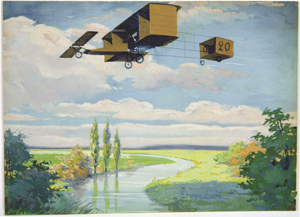
[Octavie No. 3 biplane of 1909]

Chromolithograph, 13.6 x 18.6 cm.   
XP-XL-41 (3226)


Gimbel's notes for this print, found on a separate card, read: "This pictures the Voisin Biplane of 1908 when Farman carried [the] first passenger, Leon Delagrange." But Gimbel was in error: the print depicts an aircraft somewhat different from Henri Farman's as it appeared on the flight of March 28, when it made a hop of 600 feet. That aircraft did not have a wheel under the nose, and it had not yet been fitted with the side-curtains between the planes, both of which are evident in the print. The number "20" on the empennage is certainly for the Reims aviation meet, held August 22 to August 29, 1909, from which we can conclude that the plane is the Octavie No. 3 built for Louis Paulhan and first flown on June 7, 1909. Among the 38 aircraft and 22 pilots entered at the Reims meet, the pictured plane distinguished itself by establishing a new duration record of 2 hours, 43 minutes, and took third place for distance by covering about 80 miles. The print is in a carved frame decorated with a balloon and kite.


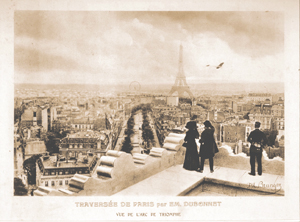
Traversée de Paris par Em. Dubonnet

M. Branger
Collotype, 25.7 x 37.5 cm.   
XP-XL-19 (1792)


The first overflight of a major city by airplane is attributed to the Count de Lambert (Wilbur Wright's first pupil), who excited the Parisian populace on October 18, 1909, by circling the Eiffel Tower in a Wright airplane. But when Emile Dubonnet "aeroplaned" across the city on the afternoon of April 24, 1910, there was an even greater sensation. In a flight of about 42 miles Dubonnet crossed over the Place de la Concorde and flew down the Champs Elysées, all at an altitude of 200 feet, occasionally rising to 300. At such a height he was affected by eddies from the buildings, which he sometimes found "difficult to negotiate." Dubonnet was a pilot for Tellier Works, makers of speedboats and constructors of the monoplane shown in this print. (Lambert's flight is commemorated in print XP-XL-19 1801, "de Lambert im Wrightflieger über Paris.")


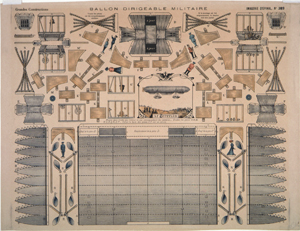
Ballon dirigeable militaire

(Paper cut-out model.)  Above: Grandes constructions.  Imagerie d'Épinal, no. 389.
Lithograph, colored, 36 x 44.6 cm.  (image)
XP-XL-19 (1782)


"Le Zeppelin" is one of a series of paper cut-out models collected by Gimbel.  When assembled, the model would be about 13 inches long; at center can be seen a small vignette showing the airship in flight. The model probably dates from about 1910, as it emulates the Zeppelins made between 1905 and 1910. In 1910 five Zeppelins began to be used for a tourist service in Germany that carried over 35,000 passengers until the beginning of the World War in 1914.


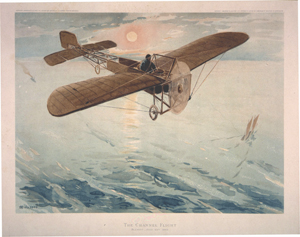
The Channel Flight: Blériot—July 25th, 1909

H. Delaspre
London, [1909?]. 
Chromolithograph, 33.7 x 44.7 cm.   
XP-XL-19 (1803)


The wealthy Louis Blériot began dabbling in airplanes in 1906; committed to monoplanes, he built three during 1907, the last of which included most of the features we associate with the modern airplane, although neither wing-warping nor ailerons were used with the main wings. Two years later, in July 1909, he won the Daily Mail prize of £1,000 by flying across the English Channel from France to England in his monoplane No. XI, an aircraft with a wingspan of about 25 feet, powered by a 25-horsepower engine. The event attracted wide attention and the reputation of Blériot as an airplane builder was assured.